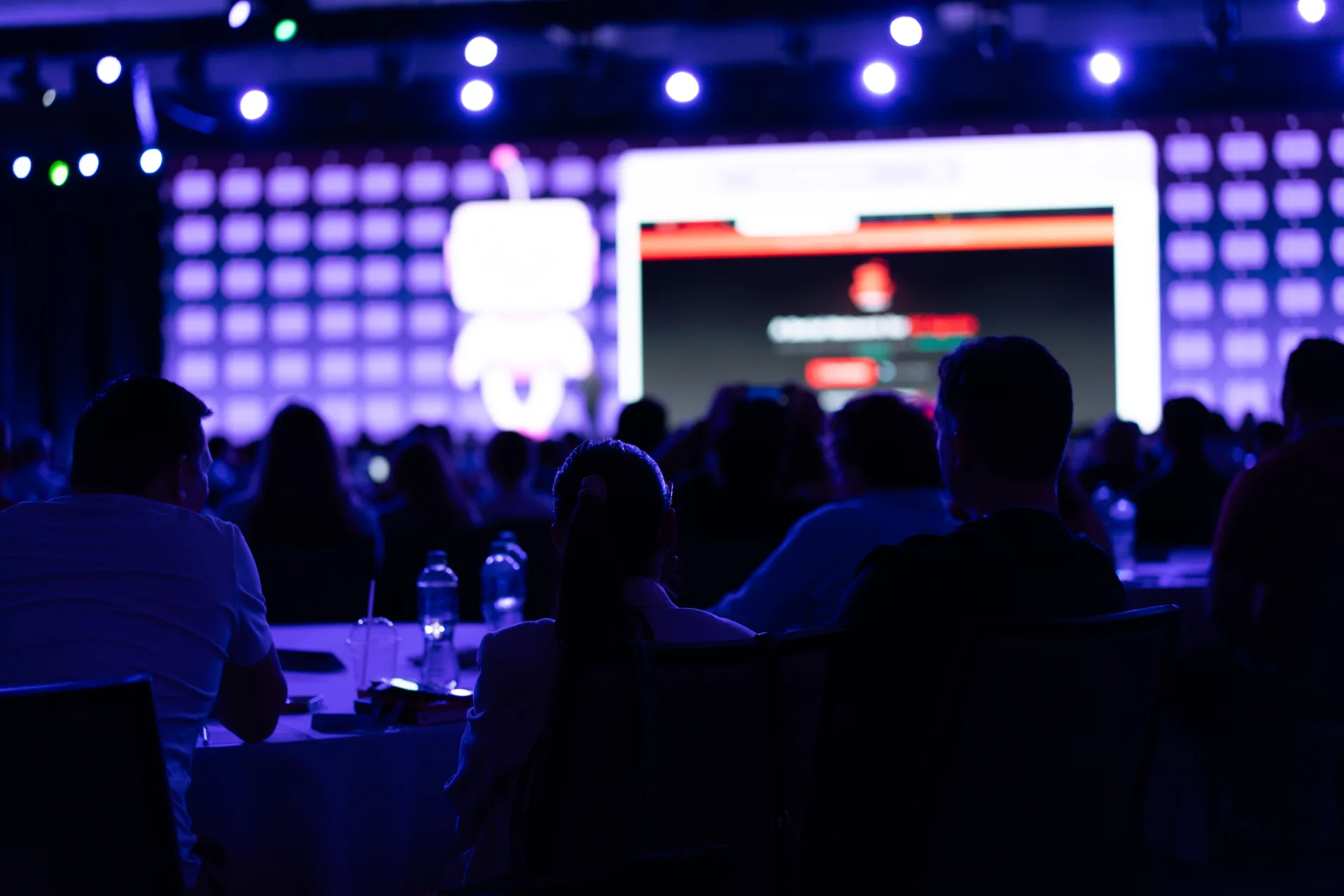
A Night of Hope gala is a seated fundraising dinner with a live program: cocktail reception, plated service, paddle raise or live auction, honoree remarks, and an awards or recognition block that cannot overrun the room. This case study documents how we scoped and ran full AV and show management for that format — LED wall and IMAG, intelligent lighting looks, dual-zone audio, and a written cue-to-cue so F&B and the show caller were never negotiating dessert clearance from the floor.
Request a consultation for gala or awards production, or review our galas and awards overview, corporate gala production guide, and stage production services.
Client and event profile
Industry: Corporate and nonprofit fundraising Event type: Night of Hope gala — cocktail reception, seated dinner, paddle raise, honoree remarks, awards recognition Production scope: Stage and scenic, ultra-wide LED, intelligent lighting, line-array audio, IMAG cameras, show calling, and technical direction Venue constraints: Hotel ballroom with a fixed load-in dock window, house dimmer that production does not own by default, and a dinner-service clock that will not wait for a late awards segment
Hotel galas fail in the handoffs. The room has to feel premium for donors without turning the head table into a concert thrust. The paddle raise needs broadcast-level timing while dessert is still moving. Load-in has to clear the dock before banquet sets tables — not after.
Production milestones — what to lock when
Fundraising galas punish decisions that drift into the final month. We anchored the advance to fixed handoff dates so development, F&B, and production planned around each other:
- 1.12 weeks out — Stage footprint, LED canvas size, and cable-path sketch submitted to the venue for dock, power, and house-light review
- 2.8 weeks out — Awards and paddle-raise run-of-show draft with presenter count, video-roll inventory, and walk-on music cues shared with the development team
- 3.6 weeks out — IMAG camera positions and house-light presets walked in the actual ballroom (not a PDF), including seated-height sight lines from the rear tables
- 4.4 weeks out — Wireless channel plan against hotel RF; backup playback format confirmed with content owners
- 5.3 weeks out — Load-in / strike sequence signed by hotel banquet and security; no overnight hold assumed unless the contract says so
- 6.72 hours out — Tribute videos, slide decks, and lower-thirds in the playback queue with labeled backup at FOH; no new content without a numbered cue revision
- 7.Rehearsal day — Full cue-to-cue on the actual stage marks, with presenters in show mics — not a tech-only dry run
If the venue cannot commit to those milestone dates in writing, treat it as a scope risk, not a scheduling detail you will solve on load-in day.
Advance questions for hotel-ballroom galas
Lock these answers before you draw a stage plot — banquet staff will not negotiate them while tables are going down:
- Dock and load-in window — When can trucks arrive, how many, and does banquet own the room before production is struck?
- House-light authority — Who controls dimmers during the show, and can production call a blackout for IMAG without a 20-minute engineering walk?
- Power — Dedicated circuits at the stage, available amperage, and whether the house electrician can tie in during load-in
- Rigging vs ground support — Ceiling points, weight limits, chandeliers, and whether the hotel allows flown LED or only ground-stacked walls
- Cable paths — Where cable can cross guest aisle, what ramps or mats banquet requires, and fire-marshal rules for the ballroom
- Airwall and overflow — Whether a second room opens mid-event and who owns audio in that zone
- Photography policy — Flash restrictions, tripod rules, and whether donor communications need a camera pass separate from the live IMAG feed
Production specs at a glance
Bring these to the vendor advance — fundraising galas punish vague scope:
- Stage footprint — Ground-supported or modest flown deck sized for presenter width, lectern, and confidence monitors; no last-minute thrust that eats table count
- LED / IMAG — Ultra-wide wall for live camera and branded content; redundant playback at FOH; camera positions tested against dinner and awards house-light states
- Audio — Dual-zone line-array (reception standing vs seated dinner); wireless inventory for emcee, honorees, auctioneer/paddle caller, and a spare; paddle calls verified from the back row
- Lighting — Four distinct looks (walk-in, dinner, paddle raise, awards/video); house-light coordination for IMAG; awards look rehearsed as a timed cue
- Show management — Single intercom loop (stage manager, LD, A1, V1, client point); numbered cue sheet with department owners and backup paths
- Load-in / strike — Written sequence aligned with banquet; strike order defined before the first case comes off the truck
The production challenge
Night of Hope had three goals that do not naturally agree.
First, the ballroom had to feel like a premium fundraising night — not a corporate general session with tablecloths. Second, the paddle raise and awards block needed tight cueing (names, walk-ons, video rolls) while dinner service ran on a separate clock. Third, load-in and strike had to respect hotel dock hours, which meant no midnight “we’ll figure it out” option after banquet wanted the room.
Technical constraints included a wide but relatively shallow seating plot that punished rear sight lines, a house dimmer production did not own by default, and a mix of standing reception and seated dinner that required separate audio zoning. The advance packet flagged chandelier clusters, airwall pockets, and fire routes before truck arrival so the stage plot never assumed a rigging point that did not exist.
Donor sight lines and seating tiers
Ticket tiers at fundraising galas often map to seating sections — and rear tables still paid for the night. We walked every section at seated height and marked where IMAG became mandatory:
- Front third — Direct sight to stage and LED; IMAG supplements presenter faces during awards, not replaces the live view
- Mid room — LED content readable; presenter faces need IMAG at awards lighting levels
- Rear and side tables — IMAG is the primary sight-line product; camera framing and lower-third scale tested from the farthest paid seat, not from FOH
- Standing reception zone — Separate audio zone; no assumption that cocktail guests migrate to seats before the program starts
Shallow ballrooms punish planners who size IMAG for the head table. The camera plot was built from the back table first, then verified forward.

Production deliverables
We scoped and executed the following production elements:
- Stage and scenic — Presenter-width deck, lectern, confidence monitors, and a clean branded backdrop that photographed for donor communications
- Ultra-wide LED wall — Live IMAG plus branded content; native canvas size locked before motion design started; redundant playback laptop at FOH
- Intelligent lighting — Named looks for walk-in, dinner, paddle raise, awards, and video playback; house-light coordination so camera shots stayed usable
- Line-array PA with zone control — Even coverage for seated dinner without blasting the cocktail corridor; wireless handheld and lav inventory for emcee, honorees, and paddle caller
- Show caller and technical director — Single comms chain linking stage manager, lighting, audio, video, and the client point
- Cue-to-cue rehearsal block — Dedicated time for awards order, video rolls, paddle-raise graphics, and walk-on timing before doors
- Load-in / strike schedule — Written sequence aligned with hotel banquet and dock hours
Advance and show-calling workflow
Galas fail in the handoffs — not the gear. We built the run of show around a single comms chain and a cue sheet every department owned before load-in finished.
- 1.Advance packet to banquet and engineering — Stage plot, cable paths, power ask, house-light presets, and a list of immovable objects (chandeliers, airwalls, fire routes) signed off before truck arrival
- 2.Separate clocks for F&B and show — Dinner service timing owned by banquet; paddle raise and awards timing owned by the show caller; no mid-cue negotiations about dessert clearance
- 3.Content lock 72 hours out — Tribute videos, slide decks, paddle-raise graphics, and lower-thirds in the playback queue with labeled backup media at FOH
- 4.Dedicated cue-to-cue rehearsal — Full awards order, video-to-live transitions, and paddle-raise graphic hits practiced with presenters, not just techs
- 5.Zone audio check at both room states — Reception standing density and seated dinner layout verified separately; paddle calls tested from the back row before doors
- 6.Strike sequence written before load-in — Truck order, cable pull priority, and what leaves first when banquet needs the room back
The show caller ran a single intercom loop: stage manager, lighting, audio, video, and the client point. Every cue had a number, a department owner, and a fallback if the primary path failed (backup laptop for playback, spare wireless at stage left).
Stakeholder roles and comms
Fundraising galas have more owners than a product keynote. Assign these before load-in:
- Show caller (production) — Owns the numbered cue sheet, intercom discipline, and timing between program segments; does not negotiate F&B changes mid-show
- Development or client point — Approves run-of-show order, honoree names, paddle-raise script, and any deviation from the locked content; the only voice on stage-content changes
- Banquet lead (hotel) — Owns the dinner-service clock; receives milestone pings from the show caller (doors, dessert hold, awards start)
- Hotel engineering — Sign-off on power, house-light presets, and any dimmer handoff production needs during IMAG
- Security / dock — Load-in door schedule, badge list, and truck staging rules
Escalation on show day: tech issues go to the TD and show caller; guest-facing issues go to the client point; anything touching house dimmers or fire routes goes to engineering before production moves gear.
Paddle raise and awards segment
The paddle raise runs on a different rhythm than awards — faster graphic turnover, louder room energy, and spotters who are often not on comms. We treated it as its own mini-show: dedicated wireless channel, preset lighting look, and a separate audio trim from the seated dinner baseline.
- Caller wireless on a dedicated channel — Not shared with presenter lavs; gain structure verified before the segment opens
- Preset lighting look — Brighter house than awards, still camera-safe for donor photo moments
- Spotter path — Floor spotters need a clear path that does not cross the show-caller channel
- Graphics locked 72 hours out — Giving levels and lower-thirds pre-built; no ad-hoc slide builds during the segment
- Audio zone handoff — Cocktail corridor dampened during paddle calls so back-row tables could hear amounts without FOH riding faders mid-cue
- Timed handoff to awards — Show caller owned the transition clock from last ask to first honoree; lighting rebuild rehearsed as a numbered cue
The paddle raise finished inside the window banquet had blocked for dessert — which only happened because production and F&B shared a written timeline, not because someone negotiated it from the floor.

Show-day timeline
Fundraising galas punish planners who treat show day like a single clock. We ran two parallel schedules — F&B service and production — with fixed handoff points:
- 1.T-4 hours — Final walk-through with banquet and engineering; cable mats verified; house-light presets confirmed on the hotel dimmer
- 2.T-3 hours — Stage plot locked; wireless frequencies scanned against hotel RF; IMAG cameras framed against dinner and awards looks
- 3.T-2 hours — Reception zone audio live; line-array trim verified at standing density in the cocktail corridor
- 4.T-90 minutes — Presenters mic-checked in show positions, not at a lectern off-stage; confidence monitors tested at presenter eye line
- 5.T-60 minutes — Cue-to-cue block: awards order, video rolls, paddle-raise graphics, walk-on music, house-light rebuild between segments
- 6.Doors — Walk-in lighting look; separate audio zone for reception; show caller on comms with banquet for dinner-service milestones
- 7.Dinner service — Seated layout audio trim; paddle-caller wireless checked from back-row tables; IMAG switched to dinner-safe exposure
- 8.Paddle raise, then awards — Numbered cue sheet active; backup playback armed; stage manager calling transitions while banquet holds dessert
- 9.Close and strike — Written pull order begins on cue; dock window respected
If the venue cannot give you a dedicated rehearsal window before doors, negotiate it in the contract — not during the pre-show huddle.
Outcomes
The production team delivered results across guest experience, program flow, and operational discipline:
- Paddle raise and awards ran on schedule — No unscripted gaps waiting for slides or mics; walk-on music and lighting hits landed on show-caller cues
- Rear and side sight lines held — IMAG kept presenter faces and giving graphics legible from back tables
- Audio intelligibility held in the money seats — Paddle calls and honoree remarks were clear without staff repeating lines from the floor
- Load-out completed inside the dock window — Banquet operations resumed on time; no overtime surprise on the hotel bill for production’s clock
- Content pipeline stayed ahead of show day — Video rolls and decks were in the production queue 72 hours before doors, with a labeled backup laptop at FOH
- House-light handoff stayed clean — Engineering presets were confirmed before doors; IMAG never fought a dinner wash that nobody could kill
- Presenter confidence held through transitions — Honorees returned from video rolls to live remarks without a visible scramble
- Stakeholder roles stayed clear through strike — No mid-show debates about who could call a dimmer preset or hold dessert
Lessons for fundraising galas
Hotel-ballroom galas reward planners who treat banquet as a collaborator, not a catering add-on:
- Advance with banquet and engineering early — Dock, power, dimmers, and cable paths before you draw a stage plot
- Design for photography, not just the live room — Donor communications often matter as much as the in-room experience; lighting for cameras is not lighting for dinner
- Separate dinner service timing from show timing — Assign an owner for each clock; the show caller should not be negotiating dessert mid-cue
- Budget rehearsal as a line item — Galas fail in the transitions (video to live, paddle raise to awards, awards to close)
- Plan strike before load-in — Know what leaves first when the hotel wants the room; truck order should be written, not improvised
- Treat IMAG as a sight-line product — Rear tables need presenter faces and graphics at readable scale; camera placement matters as much as pixel pitch
- Scope the paddle raise as its own segment — Dedicated wireless, lighting look, locked graphics, and a written handoff to awards
From the floor
During rehearsal, someone asked whether we could skip the separate awards lighting look “to save five minutes.” We did not skip it. On show night, three honorees in a row had pre-recorded tributes followed immediately by live remarks — the sequence where house lights at the wrong level makes the return to stage look like an accident.
The dedicated awards look took under fifteen seconds to build in rehearsal. On show night, nobody noticed the lighting. That is the point. The comments that came back were about the honorees — which is what a Night of Hope gala is supposed to produce.
After the last paddle ask, the caller handed the mic back without a dead-air gap. The numbered cue picked up the awards lighting rebuild on time. Banquet did not have to stall dessert.
For gala and awards production, stage design, intelligent lighting, LED walls and IMAG, line-array audio, the corporate gala production guide, and awards show cue-to-cue planning, request a consultation.