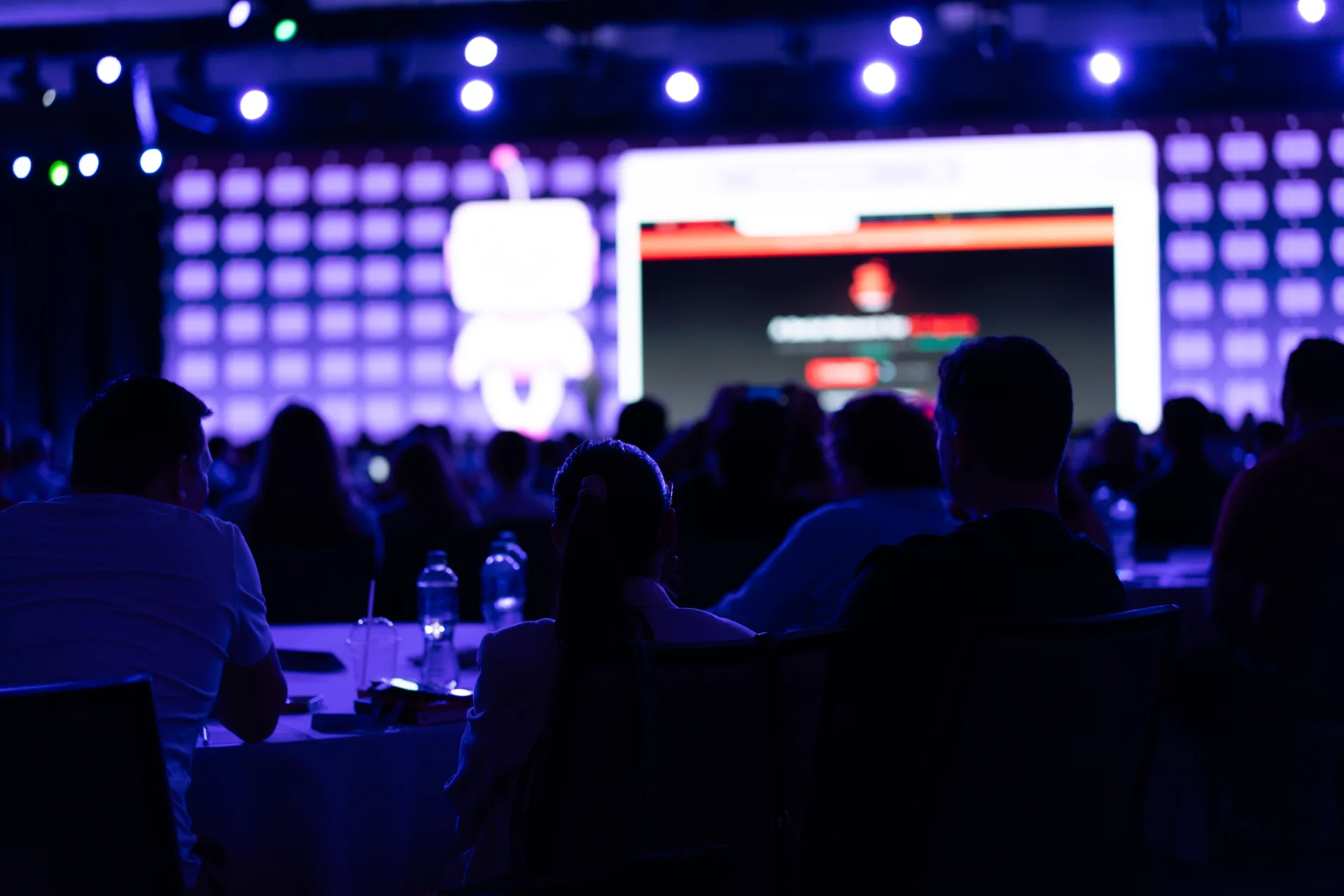
Awards show cue-to-cue is where the program stops being a spreadsheet and becomes a show — presenter walk-ons, envelope reveals, video rolls, and lighting presets either land together or they don't. Your first pass doesn't need to be perfect. It needs to be complete enough that the show caller, lighting director, and video shade are reading the same document when rehearsal starts.
This guide covers what planners should lock before that first cue-to-cue: the beats to document, the turnover rules that prevent mic chaos, and the rehearsal sequence that catches sync problems while you still have time to fix them.
Document the awards beats before anyone hits "go"
Corporate awards segments compress a lot of technical motion into short windows — a presenter walks, a graphic fires, house lights shift, IMAG cuts, and walk-on music ducks under VOG. If those sub-cues aren't in the run-of-show, the show caller is building the show in real time while twelve people wait in the wings.
Awards beats to define in writing before cue-to-cue:
- Category open — VOG or live announcer, walk-on music in/out, lighting preset name, and whether IMAG shows a category slide or live camera.
- Presenter entrance — stage path, mark position, mic channel assignment, and whether the presenter carries an envelope or receives it on stage.
- Winner reveal — exact trigger (envelope open, name on screen, announcer line), simultaneous lighting look, and audio path for reaction/applause capture.
- Acceptance speech — time limit in the run-of-show, follow-spot assignment, teleprompter or confidence monitor status, and IMAG switch (presenter camera vs. graphic hold).
- Exit and reset — where the winner exits, how long until the next category, and who clears the lectern (stage manager vs. presenter self-exit).
- Video roll or montage blocks — in/out cues, house light level during playback, and whether mics stay hot for audience reaction.
If your run-of-show lists "Award Category 3 — 8:14 PM" without sub-cues, your first cue-to-cue will be a discovery session, not a rehearsal. Break every category into technical sub-cues and distribute the document to show caller, LD, TD, and A2 before load-in day.
Pre-cue checklist — what to lock first
Awards shows punish late decisions. Presenter lists, graphic templates, and mic inventory have hard dependencies — and cue-to-cue time is always shorter than anyone estimates. Lock these before your first run.
Two weeks before cue-to-cue:
- Final presenter list per category — primary and backup for every segment; no "TBD" in the wing on rehearsal day.
- Mic inventory mapped to names — wireless channel, backup channel, and whether the presenter uses lav, handheld, or lectern.
- Graphic and video pipeline locked — category slates, winner name treatments, and montage files delivered in native aspect ratio for your IMAG or LED canvas.
- Lighting preset list — named looks for walk-in, category open, winner moment, acceptance, and reset; LD programs against names, not "make it brighter."
- Show caller and department heads assigned — one person owns cue execution; TD, LD, A2, and video shade confirm comms channels.
Day of first cue-to-cue:
- Run-of-show v1 with sub-cues — times are estimates; sub-cue order is not.
- Presenter rehearsal attendance confirmed — who must be on stage vs. who can be represented by a stand-in; acceptance speeches almost always need the actual speaker.
- Wing staffing in place — stage managers, wranglers, and mic swap station manned; awards turnover fails when everyone is "helping."
- Comms check complete — show caller, wings, FOH, and video shade on defined channels; no shared channel with client walk-through traffic.
Planners who arrive at cue-to-cue without a mic map are the ones watching a presenter tap a dead lectern while the A2 scrolls a channel list. Production can fix it. They cannot fix it without stopping the run.
Questions to bring your production vendor
An awards brief that only lists "4 wireless mics, IMAG, lighting" leaves the reveal mechanics undefined — the part the audience actually remembers. Bring these to your first production meeting:
- Who owns the run-of-show — client marketing, production company, or shared; and who has final authority on cue changes once cue-to-cue starts.
- Show caller scope — dedicated show caller or shared with stage manager; confirm they have comms to every department and the final cue document.
- Turnover time per category — target seconds from exit to next presenter at the mark; if it exceeds ninety seconds, the run-of-show needs a hold or extra wing staff.
- Envelope and prop protocol — who holds envelopes pre-show, how they reach stage, and what happens if the wrong envelope appears at the mark.
- IMAG vs. program mix — separate switcher presets for in-room screens vs. stream or overflow; confirm winner graphics read on camera, not just to the live room.
- Follow-spot coordination — how spots get their marks, who calls pick-ups during acceptance speeches, and whether spots rehearse with presenters or only during full run.
- Applause and timing buffers — built-in hold after winner announcement for audience reaction, or tight automation; presenters need to know which.
- Change window cutoff — last time a run-of-show edit can be made without overtime or untested cues on show day.
Answers belong in the production brief and on the document the show caller reads at the calling position. Verbal agreements at the pre-pro meeting evaporate when three departments interpret "after the reveal" differently.
First-pass cue-to-cue sequence
Your first cue-to-cue is not a dress rehearsal — it's a technical proof that the show can run. Block time against this sequence, not against a vague "tech run."
- 1.Category isolation — run one full category three times cold: presenter entrance, reveal, acceptance, exit, reset. If turnover fails in isolation, it fails in the show.
- 2.Rapid presenter turnover drill — two categories back-to-back with no break; time mic swaps and wing traffic at show pace.
- 3.Video roll integration — play montage or nominee reel at full resolution on IMAG; confirm lighting hold, audio path, and return to live preset without dead air.
- 4.Wrong-envelope or missed-name drill — simulate a cue error; confirm show caller recovery path and who has authority to hold or skip.
- 5.Full run at pace — all categories in order with presenters at actual speed, including applause and acceptance timing; stopwatch the total against your program window.
- 6.Stream or overflow check — watch the switcher output on a confidence monitor sized like your delay screens; a reveal that reads in the ballroom can be illegible on IMAG.
Document fixes as run-of-show edits, not verbal notes. The second cue-to-cue should run from an updated document, not from "we fixed that in the first run."
From the floor: the category that ran twice
One corporate awards rehearsal hit the winner reveal perfectly — envelope open, name on IMAG, follow-spot pickup — and then the presenter started a thank-you speech while the run-of-show was already on the next category's walk-on music. Two presenters were in the wings. One was supposed to be on stage. The show caller held the reset while someone scrolled the document to find where the skip happened.
The run-of-show had listed categories by number. The graphic server had labeled files by sponsor name. Same sequence, different vocabulary.
The fix was a single column in the cue sheet — category number, sponsor name, and exact graphic file name on one line. No aliases. The show didn't get shorter. The wing got quieter.
Awards show cue-to-cue is not about owning every fader move. It's about owning the document — beats, mic map, turnover rules, and the sign-offs that keep departments reading the same version when rehearsal pressure starts.
For lighting design, IMAG coordination, and show-day calling on your next awards program, see our event lighting services. Ready to walk through your run-of-show, presenter turnover, and first cue-to-cue plan? Request a consultation.