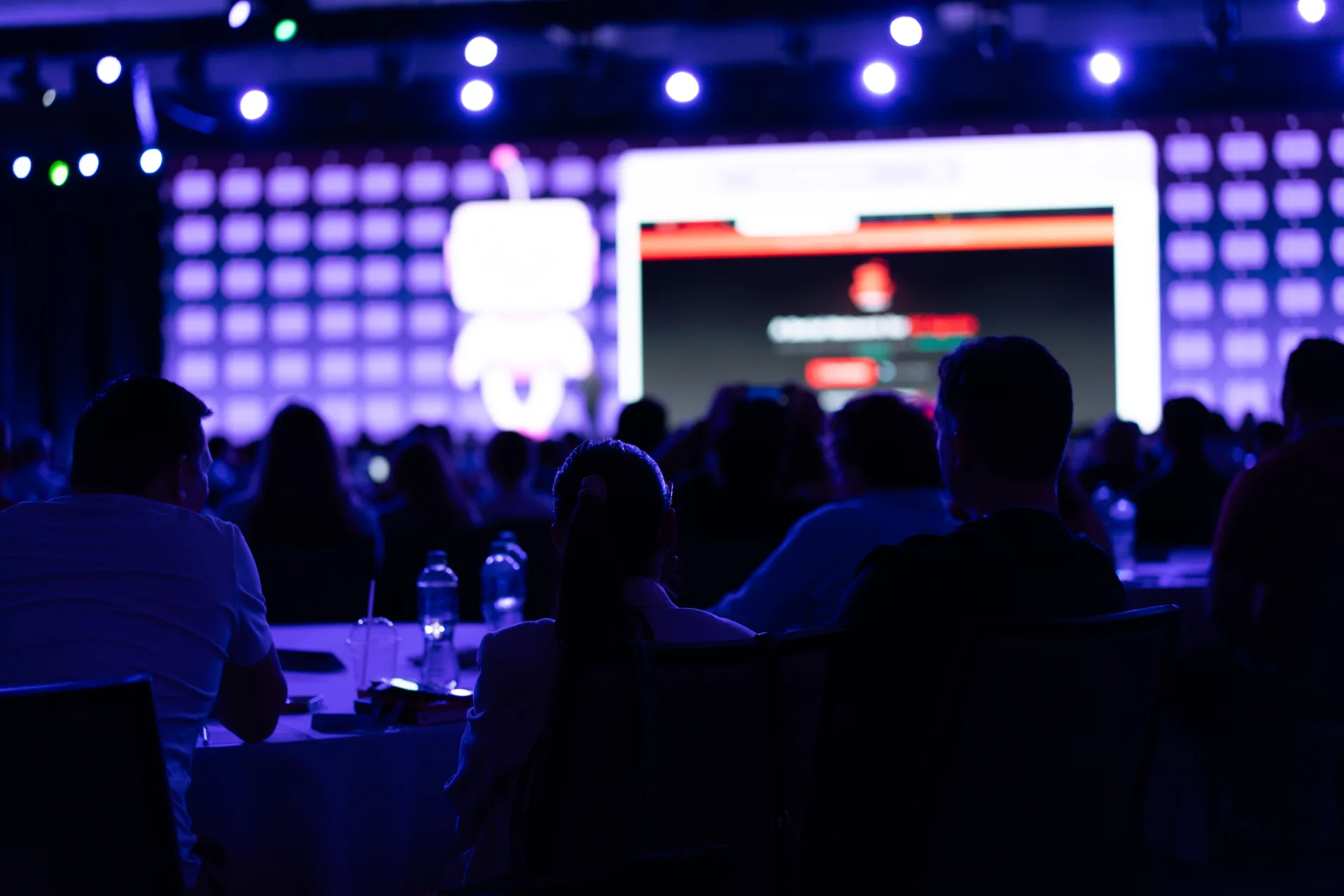
Museum gala production inside a working cultural campus — not a hotel ballroom — means ground-supported staging, dual-zone audio, IMAG sight lines, and a cue-to-cue awards flow that cannot overrun curatorial hold times. This case study covers how we scoped and ran full AV and show management for the Heard Museum annual fundraising gala: seated dinner, live auction, and recognition segment where load-in windows, artifact adjacency, and donor sight lines all compete for priority.
Request a consultation for museum gala or cultural institution production, or review our galas and awards overview, AV production services, and stage production services.
Client and event profile
Industry: Arts and cultural fundraising Event type: Annual gala — cocktail reception, seated dinner, live auction segment, awards presentation, and closing remarks Production scope: Stage design, intelligent lighting, line-array audio, IMAG on LED, show calling, and technical direction Venue constraints: Historic campus with limited overnight hold, shared load-in access with daytime operations, and strict rules about rigging and weight on preserved surfaces
Museum galas sit in an awkward middle ground: they need the polish of a corporate awards show, but the venue is not a ballroom built for touring truss. Planners often underestimate how much the building itself becomes a production character.
Production milestones — what to lock when
Museum galas fail when production decisions drift into the final month. For this event, we anchored the advance to fixed handoff dates so facilities, curatorial staff, and the development team could plan around production — not react to it:
- 1.12 weeks out — Stage footprint, ground-support positions, and cable path sketch submitted to facilities for surface and weight review
- 2.8 weeks out — Awards run-of-show draft with video roll inventory, presenter count, and walk-on music cues shared with the development team
- 3.6 weeks out — IMAG camera positions and house-light presets tested against both dinner and awards looks in a site walk (not a PDF review)
- 4.4 weeks out — Wireless channel plan and RF scan scheduled against campus inventory; backup playback media format confirmed with content owners
- 5.3 weeks out — Load-in / strike sequence written and signed by museum security; overnight hold answer locked in writing
- 6.72 hours out — All tribute videos, slide decks, and lower-thirds in the playback queue with labeled backup at FOH; no new content accepted without a numbered cue revision
- 7.Rehearsal day — Full cue-to-cue block on the actual stage positions, with presenters in show mics — not a tech-only dry run
If your venue cannot commit to milestone dates in the contract, treat that as a scope risk — not a scheduling detail you will solve on load-in day.
RFP checklist — what to require from your production partner
Museum galas get vague scopes because planners copy ballroom language into a campus that does not behave like one. Before you sign, confirm your vendor can answer these in writing:
- Ground-support plan — stage plot with weight distribution, surface protection, and zero overhead rigging assumptions unless facilities sign off
- Dual-zone audio design — separate trim for reception standing density and seated dinner layout, with auction calls verified from the back row at both states
- IMAG from the worst seat — camera positions and lower-third scale tested from the farthest paid table, not from FOH
- Numbered cue sheet with department owners — show caller, LD, A1, V1, and client point on one intercom loop; backup paths for playback and wireless documented
- Written load-in / strike sequence — aligned with museum security and curatorial hold points; strike order defined before the first case comes off the truck
- Content lock policy — 72-hour cutoff for tribute videos, slide decks, and lower-thirds; no ad-hoc additions without a numbered cue revision
- Rehearsal block on actual positions — cue-to-cue with presenters in show mics, not a tech-only dry run at a lectern off-stage
If a vendor cannot commit to milestone dates and a written strike sequence in the proposal, the gala will cost more in change orders than the line items you skipped.
Advance questions for museum venues
Lock these answers before you draw a stage plot — museum staff will not negotiate them on load-in day:
- Overnight hold — Can production stay set overnight, or must everything clear by a fixed hour? Strike order depends on this answer.
- Rigging and weight — Which surfaces accept load, which are off-limits, and who signs off on ground-supported positions?
- Cable paths — Where can cable cross public space, and what surface protection (mats, ramps, tape specs) does facilities require?
- House-light authority — Who controls dimmers during the show, and can production call a blackout for IMAG without a 20-minute facilities walk?
- Curatorial hold points — Which galleries, cases, or sculpture bases cannot move; what is the minimum clearance from stage edge?
- Security and access — Load-in door schedule, badge requirements, and whether vendor vehicles can stage on campus or must shuttle from the street
- Photography policy — Flash restrictions, tripod rules, and whether donor communications need a separate camera pass from the live IMAG feed
- Power tie-in and generator policy — Which circuits production may use, whether a generator is permitted on campus, and who signs off on distro before load-in
- RF inventory on campus — Security radios, building automation, and any fixed wireless systems that share UHF bands with presenter mics
RF and wireless planning on cultural campuses
Hotel ballrooms publish RF coordination as a line item. Museum campuses rarely do — until six presenter lavs, an auctioneer handheld, intercom IFB, and a campus security net all land on overlapping spectrum during the cocktail hour.
For this gala, we scheduled a site RF scan four weeks before load-in and again on show morning. The first pass found a security repeater in the UHF band that did not appear on any advance packet. The second pass caught guest cell density at reception — enough to raise noise floor on backup channels if we had not pre-assigned fallbacks.
- Campus RF inventory request — Ask facilities and security for a list of fixed wireless systems (radios, door access, building automation) before you allocate mic channels
- Scan at two room states — Empty campus during weekday load-in tells you one story; standing reception density at doors tells another
- Dedicated auction channel — Never share the auctioneer handheld with presenter lavs; gain structure and squelch verified before the paddle segment opens
- Intercom isolation — Production intercom on its own band or wired loop; do not stack IFB and presenter wireless on adjacent channels without a scan
- Backup channel map — Every primary wireless assignment gets a pre-planned fallback channel written on the cue sheet, not chosen from the floor
- Show-morning re-scan — Campus operations change daily; a 30-minute RF pass before doors catches new interference from neighboring events or vendor gear
If your venue cannot provide an RF contact or a quiet window for a scan, budget an extra half-day on load-in for wireless coordination — not a five-minute check at the lectern.
Power distribution on cultural campuses
Museum facilities teams think in terms of gallery circuits and preservation — not a touring distro package with six moving-light racks and a 40-foot LED wall. Production power on a cultural campus is negotiated, labeled, and photographed before the first lamp turns on.
For this gala, we submitted a one-line power ask eight weeks out: total amperage by position, cable path from the tie-in to stage left and FOH, and a list of what stays on campus power versus what cannot run on shared circuits with house dimmers. Facilities returned a marked floor plan with three approved tie-in points and one surface where a generator was explicitly forbidden — adjacent to a preserved courtyard wall.
- Amperage budget by position — Stage, FOH, LED processor rack, and catering warmers on separate line items; no lump-sum "production power" that facilities cannot map to breakers
- Tie-in location photos — Facilities signs off on distro placement with dated photos; strike photos match load-in positions so nothing gets disputed at hard out
- House dimmer isolation — Production cannot share a circuit with museum house-light presets; confirm which breakers the LD may not touch during the show
- Generator rules in writing — Distance from walls, exhaust path, noise curfew, and fuel delivery window; many campuses ban generators entirely
- Cable path overlap with guest routes — Power runs parallel to AV cable paths but on separate mats where possible; facilities approves both on the same advance drawing
- First power-on sequence — LED processors and moving lights powered in stages so facilities can verify draw before the full rig is live
Ground-fault and weather matter when cocktail hour spills onto a courtyard terrace. We kept all distro under covered mats with labeled cord caps — not because the museum required it for the indoor room, but because the reception zone crossed an exterior door that stayed open for two hours.
Campus load-in, truck access, and strike logistics
Museum campuses are not convention centers. Truck access, badge lists, and strike windows are negotiated weeks before load-in — not resolved when the first case hits the dock.
- Vehicle staging map — Which gate accepts production trucks, where cases can sit before push-in, and whether shuttle runs are required from street parking
- Badge and escort list — Named crew on the security roster; no day-of additions without a facilities contact who can approve access after hours
- Push-in sequence — Which cases enter first (deck, then audio, then LED) so the stage footprint is defined before cable paths are laid
- Surface protection inventory — Mat count, ramp specs, and tape color approved by facilities; spare mats staged at the load-in door, not ordered on show morning
- Shared access with daytime operations — Which paths stay open to staff or visitors during load-in; signage and barricade plan signed by security before trucks arrive
- Strike photography — Facilities or curatorial staff may require photos of every position before gear moves; assign someone to capture strike shots as pull order executes, not after the truck is half loaded
- Hard out time in writing — The hour the room must be clear, who signs off, and what happens to gear still on the floor at T+0 (usually: it does not stay)
For this gala, load-in ran on a single dock window with no overnight hold. Strike started on a numbered cue from the show caller — not when the last guest left — because the museum needed the room back for a morning tour group. That only worked because pull order and truck packing were written before the first case came off the truck.
Production specs at a glance
Bring these to your vendor advance — museum galas punish vague scope:
- Stage footprint — 24×16 ground-supported deck, four-presenter width, confidence monitors downstage center, no overhead rigging on preserved surfaces
- LED / IMAG — ultra-wide 16:9 wall for live camera and branded content; redundant playback laptop at FOH; camera positions tested against house-light states before dinner
- Audio — dual-zone line-array (reception standing vs. seated dinner); six wireless channels (presenters, auctioneer, emcee, spare); auction calls verified from the back row at both room layouts
- Lighting — four distinct looks (walk-in, dinner, awards, video playback); house-light coordination for IMAG; awards look rehearsed as a timed cue, not a live improvisation
- Show management — single intercom loop (stage manager, LD, A1, V1, client point); numbered cue sheet with department owners and backup paths for playback and wireless
- Load-in / strike — written sequence aligned with museum security; no overnight hold; strike order defined before the first case comes off the truck
- Power — distro from approved campus circuits only; no generator on preserved surfaces; tie-in signed by facilities before first powered-on test
- Wireless — six-channel plan with dedicated auction frequency, intercom on isolated band, backup map on the cue sheet; RF scan at load-in and show morning
The production challenge
The Heard Museum gala had three simultaneous goals that do not naturally agree with each other.
First, the room had to feel premium for major donors without turning the stage into a concert rig that overpowered the art and architecture guests came to support. Second, the awards and recognition segment needed broadcast-level timing — names, walk-ons, and video rolls cued tightly — while dinner service continued on a separate clock. Third, load-in and strike had to respect museum operating hours, which meant no “we’ll figure it out at midnight” options.
Specific technical constraints included limited rigging (ground-supported staging and lighting positions only), a wide but shallow audience depth that punished rear sight lines, and a mix of seated tables and standing reception zones that required separate audio zoning. The advance packet flagged every immovable object before truck arrival — display cases, sculpture bases, and fire routes — so the stage plot never assumed a rigging point that did not exist.
Donor sight lines and seating tiers
Ticket tiers at museum galas often map directly to seating sections — and rear tables pay the same premium as front rows. Before load-in, we walked every section at seated height and marked where IMAG became mandatory versus optional:
- Front third — Direct sight to stage and LED wall; IMAG supplements presenter faces during awards, not replaces the live view
- Mid room — LED content readable; presenter faces need IMAG at awards lighting levels; confidence monitors irrelevant from here
- Rear and side tables — IMAG is the primary sight-line product; camera framing and lower-third scale tested from the farthest paid seat, not from FOH
- Standing reception zone — Separate audio zone; no assumption that cocktail guests will migrate to seats before the program starts
Shallow rooms punish planners who size IMAG for the front row. The camera plot for this gala was built from the back table sight line first, then verified forward.

Production deliverables
We scoped and executed the following production elements:
- Ground-supported stage and scenic — sized for four-presenter width, confidence monitors, and a clean backdrop that photographed well for donor communications without blocking architectural features
- Ultra-wide LED wall for IMAG and branded content — 16:9 content pipeline, redundant playback, and calibration for both house lighting states and camera exposure
- Intelligent lighting design — separate looks for reception walk-in, dinner, awards, and video playback; house-light coordination so camera shots stayed usable
- Line-array PA with zone control — even coverage for seated dinner without blasting the reception corridor; wireless handheld and lav inventory for presenters and auctioneer
- Show caller and technical director — single comms chain linking stage manager, lighting, audio, video, and client point person
- Cue-to-cue rehearsal block — dedicated time for awards order, video rolls, and walk-on timing before doors, not folded into a 20-minute sound check
- Load-in / strike schedule — written sequence aligned with museum security and curatorial hold points
Advance and show-calling workflow
Museum galas fail in the handoffs — not the gear. We built the run of show around a single comms chain and a written cue sheet that every department owned before load-in finished.
- 1.Advance packet to facilities and curatorial staff — stage plot, cable paths, surface protection plan, and a list of immovable objects (display cases, sculpture bases, fire routes) signed off before truck arrival
- 2.Separate clocks for F&B and show — dinner service timing owned by the venue caterer; awards and auction timing owned by the show caller; no mid-cue negotiations about dessert clearance
- 3.Content lock 72 hours out — all tribute videos, slide decks, and lower-thirds in the playback queue with labeled backup media at FOH
- 4.Dedicated cue-to-cue rehearsal — full awards order, video-to-live transitions, and walk-on music hits practiced with presenters, not just techs
- 5.Zone audio check at both room states — reception standing density and seated dinner layout verified separately; auction calls tested from the back row before doors
- 6.Strike sequence written before load-in — truck order, cable pull priority, and what leaves first when the museum needs the room back at a fixed hour
The show caller ran a single intercom loop: stage manager, lighting, audio, video, and the client point person. Every cue had a number, a department owner, and a fallback if the primary path failed (backup laptop for playback, spare wireless on standby at stage left).
Stakeholder roles and comms
Museum galas have more owners than a ballroom show. Assign these before load-in — not during the pre-show huddle:
- Show caller (production) — owns the numbered cue sheet, intercom discipline, and timing between program segments; does not negotiate F&B changes mid-show
- Development director or client point (institution) — approves run-of-show order, honoree names, and any deviation from the locked script; the only voice on stage content changes
- Facilities lead (museum) — sign-off on cable paths, surface protection, strike windows, and house-light presets on the museum dimmer
- Curatorial liaison — holds the line on clearance from displays and sculpture; photographs strike positions when required
- Caterer lead — owns the dinner-service clock; receives milestone pings from show caller (doors, dessert hold, awards start)
- Security / access — badge list, load-in door schedule, vendor parking or shuttle rules
Escalation on show day: tech issues go to the TD and show caller; guest-facing issues go to the client point; anything touching a wall, case, or preserved surface goes to facilities before production moves gear.
Auction and paddle segment
Live auction blocks inside a museum gala run on a different rhythm than awards — faster cue turnover, louder room energy, and spotters who are not on comms. For this event, we treated the auction as its own mini-show with a dedicated wireless channel, preset lighting look, and separate audio trim from the seated dinner baseline.
- Auctioneer wireless on a dedicated channel — not shared with presenter lavs; gain structure verified before the paddle segment opens
- Preset lighting look for auction — brighter house than awards, still camera-safe for any donor photo moments development requested
- Spotter comms or hand signals — floor spotters for winning bids need a clear path to the auctioneer that does not cross the show-caller channel
- Graphics or lower-thirds optional — live lots without IMAG clutter unless development pre-planned lot graphics; no ad-hoc slide builds during the segment
- Audio zone handoff — reception corridor dampened during auction calls so back-row tables could hear lot descriptions without FOH riding faders mid-cue
- Timed handoff to awards — show caller owned the transition clock from last lot to first honoree; lighting rebuild rehearsed as a numbered cue, not a live reset
The auction finished inside the window the caterer had blocked for dessert service — which only happened because production and F&B shared a written timeline, not because someone negotiated it from the floor.
Tribute video and playback pipeline
Museum galas lean heavily on pre-recorded tribute content — family interviews, archival footage, and donor thank-you reels. Those rolls fail in predictable ways: wrong frame rate, audio embedded on the wrong channel, or a last-minute export that does not match the playback laptop’s codec list. For this event, we treated every video like a numbered cue with its own QC pass, not a file someone emailed the morning of.
- Codec and frame-rate lock at content intake — H.264, 29.97 or 23.976 only; no ProRes or variable frame-rate phone exports accepted after the 72-hour lock
- Separate audio stems when possible — tribute audio routed to the PA on a dedicated bus; house mics muted during rolls so ambient room noise does not bleed into emotional segments
- In/out points marked on the cue sheet — black frames trimmed; fade-to-black on the last frame so the LD can rebuild house lights without guessing
- Backup file naming convention — `cue-XX-primary.mov` and `cue-XX-backup.mov` on both the main and redundant playback machines at FOH
- Full-screen vs. lower-third decision locked in advance — no mid-show debates about whether a name graphic should appear over a tribute; development signed off during the 8-week run-of-show review
- Live return path rehearsed — after each roll, the honoree’s walk-on mic, lighting look, and IMAG switch were practiced as one numbered transition, not three separate departments improvising
When a tribute video ends and the honoree steps back to the lectern, the room holds its breath for about two seconds. That gap is where galas either feel polished or amateur. Rehearsal time spent on video-to-live returns pays off more than another hour tuning the LED processor.
Photography and donor communications
Museum development teams often need still photography and social coverage that does not match the live IMAG feed. Treating those as separate deliverables — not an afterthought for whoever has a phone — keeps donor communications usable the next morning.
- House-light states for stills vs. IMAG — awards look optimized for camera exposure may read too dim for a photographer shooting without flash; define a “photo-safe” preset or a brief hold window after each honoree
- Flash and tripod policy in writing — museum galleries adjacent to the gala room may have stricter rules than the ballroom itself; share the policy with the official photographer before load-in
- Stage-left clearance for photographers — a dedicated lane that does not cross cable mats or block the IMAG operator’s sight line
- Branded backdrop sight lines — scenic sized so donor grip-and-grin shots include institutional branding without cropping presenter faces
- IMAG feed vs. stills embargo — if development needs embargoed honoree photos, confirm whether the live camera feed counts as publication before show day

Show-day timeline
Museum galas punish planners who treat show day like a single clock. We ran two parallel schedules — F&B service and production — with fixed handoff points:
- 1.T-4 hours — Final walk-through with facilities; cable mats and surface protection verified; house-light presets confirmed on the museum dimmer
- 2.T-3 hours — Stage plot locked; wireless frequencies scanned against campus RF; IMAG cameras framed against both dinner and awards lighting looks
- 3.T-2 hours — Reception zone audio live; line-array trim verified at standing density in the cocktail corridor
- 4.T-90 minutes — Presenters mic-checked in show positions, not at a lectern off-stage; confidence monitors tested at presenter eye line
- 5.T-60 minutes — Cue-to-cue rehearsal block: full awards order, video rolls, walk-on music, and house-light rebuild between segments
- 6.Doors — Walk-in lighting look; separate audio zone for reception; show caller on comms with caterer lead for dinner-service milestones
- 7.Dinner service — Seated layout audio trim; auctioneer wireless checked from back-row tables; IMAG switched to dinner-safe exposure
- 8.Awards segment — Numbered cue sheet active; backup playback laptop armed; stage manager calling transitions while caterer holds dessert service
- 9.Close and strike — Written pull order begins on cue; no gear moves until curatorial hold points are photographed and signed off
If your venue cannot give you a dedicated rehearsal window before doors, negotiate it in the contract — not during the pre-show huddle.
Outcomes
The production team delivered measurable results across guest experience, program flow, and operational discipline:
- Awards segment ran on schedule — no unscripted gaps waiting for slides or mics; walk-on music and lighting hits landed within two seconds of show-caller cues
- Rear and side sight lines held — IMAG framing verified from the farthest paid seat before doors; presenter faces and award graphics stayed legible through the recognition block
- Audio intelligibility scored in the money seats — auction calls and honoree remarks were clear from back-row tables without staff repeating lines from the floor
- Load-out completed inside the contracted window — strike followed the written pull order; museum operations resumed on time with curatorial sign-off on surface photos
- Content pipeline stayed ahead of show day — all six tribute videos and slide decks were in the playback queue 72 hours before doors, with labeled backup media at FOH
- Zero unplanned rigging or surface contact — ground-supported positions and cable mats matched the advance plan; no last-minute stage resize after the 8-week footprint lock
- Wireless plan held through the awards block — morning re-scan caught a campus security carrier; presenter channels were remapped in rehearsal with no dropouts during live cues
- Auction-to-awards handoff held dinner service — lot descriptions finished inside the caterer's dessert hold window; transition to the first honoree landed as a numbered cue, not a floor negotiation
- Tribute video transitions held without dead air — every pre-recorded segment played from the primary queue; video-to-live returns were rehearsed as single numbered cues with lavs open before the last frame faded
- Stakeholder roles stayed clear through strike — facilities, curatorial, and production each had a named owner on comms; no mid-show debates about cable mats or house-light presets
- Wireless plan held through reception and awards — show-morning RF scan caught one new interference source; backup channel map was never needed, but every primary mic had a fallback assigned before doors
- Power tie-in matched the advance drawing — facilities signed off on distro positions at load-in; no mid-show breaker trips or unplanned extension cord runs across guest paths
Lessons for museum and cultural galas
Cultural institution events reward planners who treat the venue like a collaborator, not a rental shell:
- Advance with facilities and curatorial staff early — ask about surface protection, cable paths, and anything that cannot move before you draw a stage plot
- Design for photography, not just the live room — donor communications and social coverage often matter as much as the in-room experience; lighting for cameras is not the same as lighting for dinner
- Separate dinner service timing from show timing — assign an owner for each clock; the show caller should not be negotiating dessert clearance mid-cue
- Budget rehearsal as a line item — museum galas fail in the transitions (video to live, live to awards, awards to close); those transitions need dedicated practice
- Plan strike before load-in — know what leaves first when the venue needs the room back; truck order and cable pull sequence should be written, not improvised
- Treat IMAG as a sight-line product, not a screen rental — rear tables at shallow galas need presenter faces and graphics at readable scale; camera placement and house-light coordination matter as much as pixel pitch
- Scope the auction as its own segment — dedicated wireless, lighting look, and a written handoff to awards; do not fold paddle calls into a generic dinner audio preset
- QC tribute videos like live cues — frame rate, audio routing, and video-to-live return paths need rehearsal time equal to any presenter walk-on
- Plan photography lanes before scenic is built — IMAG operators and official photographers compete for the same sight lines; assign zones in the advance packet
- Write truck access and strike before load-in day — campus galas fail when the first case arrives and nobody knows which gate is open; vehicle staging and hard out times belong in the advance packet, not a group text at midnight
- Treat RF as a campus problem, not a mic rental — request security and facilities wireless inventory early; scan at load-in and again before doors when guest density changes the noise floor
- Submit a one-line power ask early — amperage by position, tie-in locations, and generator rules in writing; facilities cannot approve a distro package they cannot map to breakers
From the floor
During load-in, the RF scan picked up a security repeater nobody had listed on the advance packet. We moved two presenter channels and re-printed the cue sheet before the first mic check — which is why the show-morning scan was a formality instead of a crisis.
Facilities also flagged a tie-in point that sat six inches from a courtyard threshold the caterer planned to roll carts across. We moved distro to the approved position on the advance drawing and sent a photo before first power-on. The carts never crossed a cable mat.
During rehearsal, the museum’s development director asked whether we could “just skip the separate awards lighting look to save five minutes.” We did not skip it. During the live show, three honorees in a row had pre-recorded tribute videos followed immediately by live remarks — the kind of sequence where house lights at the wrong level makes the return to stage look like an accident.
The dedicated awards look took eleven seconds to build in rehearsal. On show night, nobody noticed the lighting. That is the point. The only visible production moment donors commented on was a honoree’s speech — which is exactly what a museum gala is supposed to produce.
After the last lot closed, the auctioneer handed the mic back without a dead-air gap. Cue forty-two picked up the awards lighting rebuild on time. The caterer did not have to stall dessert. Facilities signed off on strike photos the next morning without a single cable mat out of place.
At strike, facilities asked for photos of every mat position before we pulled cable. We had assigned that job to the stage manager during load-in planning — not as a favor at 11 p.m. The room cleared forty minutes before the hard out. The morning tour group never knew we were there.
For gala and awards production, stage design and scenic, intelligent lighting, LED walls and IMAG, line-array audio, RF microphone planning, the corporate gala production guide, and awards show cue-to-cue planning, request a consultation.