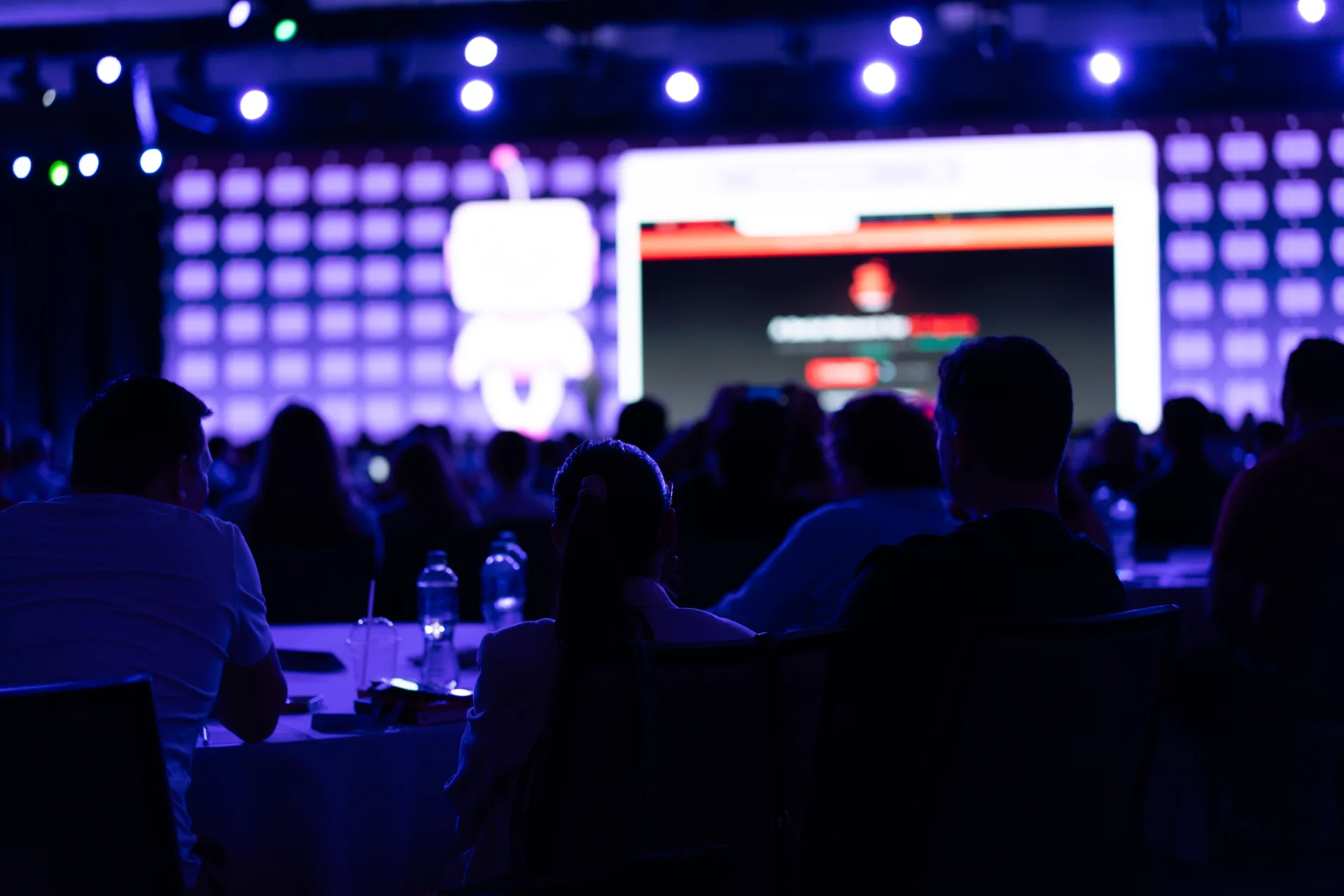
The right LED wall size comes from four decisions: viewing distance, pixel pitch, content aspect ratio, and the room’s physical limits. Set those before requesting quotes and you can compare vendors on a useful production specification instead of panel count alone.
This guide gives corporate planners a practical way to define those requirements, test sight lines, and decide when one large wall is less effective than a smaller wall with delay screens.
Start with the farthest seat, not the stage lip
Every sizing conversation should begin at the back row. Measure the distance from the last occupied seat to the face of the LED — not to the stage edge, not to the downstage scrim. That number is your governing variable.
A rough rule production teams use: for comfortable reading of slides and data, you want roughly 10–12 feet of viewing distance per meter of wall width at minimum. Tighter is fine for IMAG-heavy shows where the wall is mostly faces and motion graphics. Looser is mandatory when you're displaying 8-point financial tables to a boardroom audience spread across a ballroom.
If your venue has a fixed proscenium or ceiling height cap, work backward from that constraint first. A wall that doesn't fit in the truck dock or clears the lighting truss isn't a sizing problem — it's a load-in problem you'll discover at midnight.
Pixel pitch is a budget conversation wearing a technical costume
Pixel pitch — the distance between LED diodes — gets oversimplified as "lower number equals better." True, but incomplete. Lower pitch costs more, weighs more, and pulls more power. For a 300-person keynote where the farthest seat is 60 feet out, a 2.6mm wall is engineering overkill. You're paying for pixels nobody's retina can resolve.
Match pitch to minimum viewing distance:
- Under 10 feet (exhibit booth, stage thrust): 1.5–1.9mm — attendees are close enough to see individual modules if you go coarser.
- 10–25 feet (corporate keynote, awards downstage): 2.3–2.6mm — the corporate sweet spot for most hotel ballrooms.
- 25–50 feet (large general session, arena-style seating): 2.9–3.9mm — still sharp for IMAG and bold graphics at distance.
- Beyond 50 feet (festival scale, very deep rooms): 4.8mm+ or consider delay screens instead of one hero wall.
The pitch decision also affects your processor and cable infrastructure. Finer pitch means more pixels, which means more sending cards and more things that can fail during the CEO walk-on. A seasoned producer balances visual quality against failure surface area — because the wall that looks perfect in the quote but drops a section during the live product demo is not the wall you wanted.
Aspect ratio and content pipeline — the silent killers
Clients pick wall dimensions based on what looks impressive in a ballroom photo. Content teams build decks in 16:9. Scenic wants a cinematic 32:9 ribbon across the stage. Three stakeholders, three aspect ratios, one wall.
Lock content aspect ratio before you lock wall size. If your show runs PowerPoint, Google Slides, and a motion graphics package, audit all three. Letterboxed content on a mismatched wall reads as amateur hour — black bars on a $200K LED install is a specific kind of pain.
For split-content layouts (presenter IMAG left, slides right), size each zone independently. The slide zone needs readable type at the farthest seat. The IMAG zone can be slightly lower resolution because faces are forgiving — humans recognize faces at surprisingly low pixel counts. Data is not forgiving. Graphs lie when they're blurry; they just lie quietly.
Build a content safe zone into your spec. Most walls need edge compensation for bezels or creative masking. If your motion designer doesn't know the exact pixel count of the canvas, you'll get soft edges and cropped lower-thirds on show day. Ask your production partner for the native resolution and the safe action area before anyone opens After Effects.
Rigging, sight lines, and the room you actually have
Ballroom airwalls, chandelier clusters, and balcony overhangs all eat sight lines. A wall sized perfectly for a rectangular room becomes a partial view for the side sections when the venue sells 1,200 seats in a chevron.
Before you sign a wall size, ask for a sight-line study — even a rough one. CAD is ideal; a cross-section sketch on a napkin is better than nothing. You are looking for:
- Vertical sight lines: Can balcony row one see the bottom third of the wall, or are they staring at the presenter’s shoes on IMAG?
- Horizontal sight lines: Do extreme side seats get a acceptable viewing angle, or are they watching content at 45 degrees (text looks italicized; it isn't)?
- Obstructions: Which seats lose partial wall view to PA stacks, camera platforms, or that scenic pillar someone added after AV was booked?
Ceiling height dictates wall height before width. A 14-foot ceiling with 3 feet of trim and lighting trim height gives you a maximum wall height of roughly 10–11 feet before you're into special rigging territory. Width can flex; height often can't without structural engineering and a venue conversation nobody scheduled.
What to put in the RFP (and what vendors won't volunteer)
Most LED wall RFPs list dimensions and pixel pitch. Few list minimum acceptable character height at the farthest seat, content resolution, failover requirements, or who owns the processor spares.
Add these lines to your spec:
- Farthest-seat readability standard — e.g., "All slide text legible at 60 feet without magnification."
- Native resolution and refresh rate for all content sources feeding the wall.
- Processor redundancy — dual path or hot spare for general sessions with live broadcast.
- Load-in dimensions — module size, case count, ground support vs flown weight limits.
- Calibration window — who runs full-field calibration, and when (hint: not 20 minutes before doors).
And ask one human question in the bid review: "Show me a show like mine that you did with this exact pitch at this distance." References beat spec sheets. A vendor who can't describe a comparable room is guessing — with your budget.
When to call it — wall vs projection vs delay screens
Not every room needs a hero wall. Deep convention halls with flat floors sometimes need a center LED plus two delay screens on delay — same feed, closer to the back half. Trade shows with 20-minute booth cycles might need a smaller high-pitch wall you can rebuild daily, not a monolithic install.
Projection still wins when the content is cinematic full-bleed video with no fine type, the room is dark enough, and you have a surface that isn't beige acoustic tile. LED wins when house lights stay up, cameras are shooting ISO 800+, or the CEO's brand colors need to pop on camera without looking washed out.
If you're unsure, prototype in pre-pro: project your actual slide deck at the proposed wall size in a VR previsualization tool or even a scaled PDF printout taped to the back wall of the rehearsal room. Low tech. Saves high tech embarrassment.
From the floor: when the biggest wall was the wrong wall
One general session arrived with a 40-foot wall requirement because that was what a competitor had used. In the actual 120-foot-deep room, row 18 could see the color blocks but could not read the product specifications the CMO had spent six weeks approving. The working solution was a smaller, finer-pitch center wall plus two delay screens: lower cost, better sight lines, and considerably less explaining during rehearsal.
Sizing an LED wall is ultimately sizing the audience experience. The calculations establish the range; the production conversation makes it work in the room you actually have.
For wall specs, rigging, and processor design on your next corporate event, see our LED wall production services. Ready to walk through your room dimensions and content pipeline? Request a consultation.