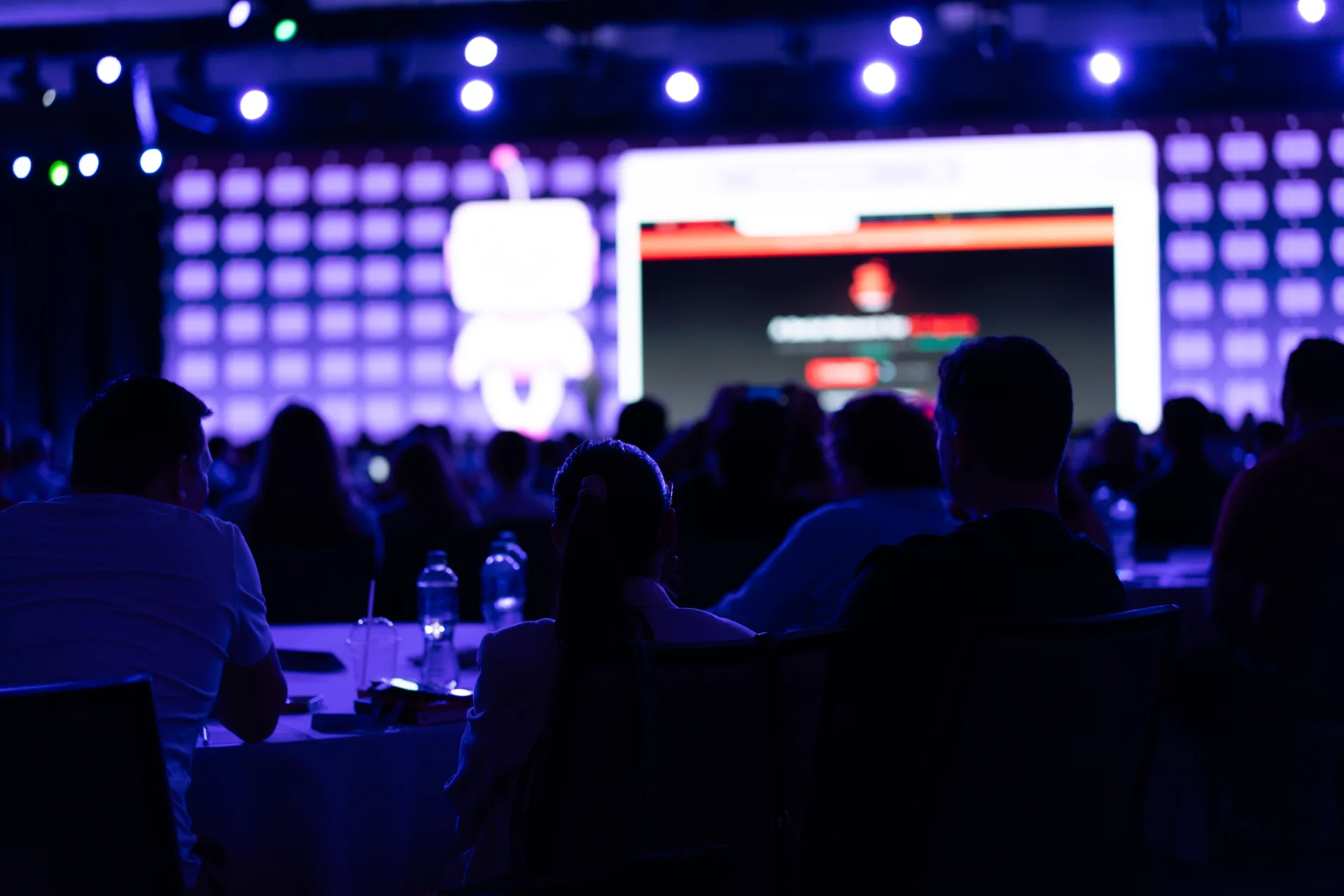
Brand guidelines were written for print, digital, and packaging — not for a ballroom with house cove lights, an IMAG crop that trims your logo, and a scenic backdrop that reads magenta on camera. This guide covers what to extract from your style guide before production locks, what to add that guidelines never mention, and how to brief vendors so the live show matches the brand your CMO approved in the boardroom. Use it when marketing and production are still in the same planning cycle, not after load-in when someone asks why the keynote looks like a different company.
Brand guidelines are a starting point, not a production spec
Most brand guides specify hex codes, logo clear space, typography, and photography tone. Live production needs different data: Kelvin on key lights, pixel dimensions for lower-thirds on a 16:9 IMAG feed, minimum contrast ratios on LED under house lighting, and scenic proportions that preserve logo aspect ratio when the stage deck scales to a 900-seat room versus a 400-seat theater.
The gap is predictable. Marketing sends the PDF. Production receives it and interprets "brand blue" as gel on a follow spot. Graphics builds walk-on slides at 1920×1080 while the switcher expects 3840×2160. Scenic prints a backdrop from an approved vector file at a scale that makes the logo occupy twelve feet when the sight-line study needed eight. None of this is malice — it is two disciplines speaking different languages with one document that was never written for either.
Aligning brand guidelines with live production means building a production brand spec — a one-to-three-page addendum that translates identity rules into show-floor requirements. Marketing owns the creative intent. Production owns the technical translation. Both sign before the RFP goes out.
What to extract from brand guidelines for live production
Not every page of the style guide belongs in the truck. Pull what affects what the audience and cameras see; leave email signature rules and social crop templates for another workflow.
Translate these brand guide elements into production-ready specs:
- 1.Primary and secondary palette with live-use notes — Hex codes plus acceptable variance on camera. Specify whether brand blue is an emissive LED color, a projected wash, or a printed scenic surface — each renders differently under tungsten house light and broadcast white balance.
- 2.Logo usage and clear space — scaled to stage — Minimum logo height on backdrop, maximum distortion tolerance, approved lockups for horizontal versus stacked marks, and forbidden treatments (drop shadows, gradients, outline versions) on scenic and IMAG.
- 3.Typography hierarchy for motion graphics — Font files licensed for broadcast, minimum point sizes at the farthest seat, safe margins for lower-thirds and walk-on bumpers, and whether the brand permits all-caps on screen when the print guide says sentence case.
- 4.Photography and video tone — Color grading references for IMAG and playback content: contrast level, skin-tone warmth, saturation ceiling. A brand that reads "bright and optimistic" in stills can look blown out on a 4.8mm pitch wall at full brightness.
- 5.Voice and motion principles — Transition speed, animation style (linear versus ease), and audio branding cues. Live show graphics that bounce like a social ad when the guide specifies restrained motion erode brand credibility in a general session.
- 6.Co-branding and partner logo rules — Size ratios when a sponsor shares the stage, placement on step-and-repeat versus live scenic, and sequence rules for walk-ons when multiple marks appear in one cue.
If the brand guide lacks live-specific guidance — most do — document the gap explicitly and assign marketing approval authority for on-site exceptions. "We'll match it on site" is not a spec.
Business outcomes when brand guidelines drive production decisions
Executives fund live events to move perception, message recall, and content reuse — not to win a color-matching argument on the loading dock. When brand guidelines translate into production standards early, marketing and finance see measurable returns instead of post-show damage control.
When production aligns with brand standards from the brief forward, leadership typically sees:
- On-brand capture without reshoot pressure — Program audio, IMAG framing, and lighting that match the approved look on the first take reduce executive time in the green room and give marketing usable clips within the planned post-event window.
- Higher content utilization from one show file — Lower-thirds, scenic, and playback that share a versioned asset package cut cleanly into sizzle reels, investor updates, and internal comms. Rework from mismatched screen sizes or off-brand color kills utilization rates.
- Consistent stakeholder perception across touchpoints — Pre-event comms, on-site environmental branding, and the general session read as one company. Drift between the registration desk and the keynote stage registers with audiences who notice details — especially analysts, partners, and press.
- Fewer change orders tied to brand rework — Late scenic reprints, emergency graphics rebuilds, and day-of gel swaps are expensive and visible. A production brand spec with sign-off before load-in converts "make it match the guide" from a crisis into a checklist.
- Clearer vendor accountability — When acceptance criteria reference documented brand specs — not a PDF nobody opened — disputes over whether the show met standard resolve against criteria both sides agreed to in advance.
Track compliance at the program level: graphics test pass, lighting variance from reference still, scenic proportion check, and capture delivery on brand. One scorecard marketing and production both read beats a post-mortem slide deck about "lessons learned."
The handoff checklist: from style guide to production brief
Most brand-production misalignment happens in the handoff — when marketing considers the guide "sent" and production considers the email "received." Before creative locks and before vendors quote, complete this handoff between brand owner and production lead.
Marketing delivers:
- Current brand guide version number and date — not a screenshot from a deck three years old.
- Logo files in formats production actually uses: vector for scenic, PNG with alpha for graphics, specified color space (RGB for screen, CMYK only if print scenic is involved).
- Reference stills or short clips of approved on-brand looks — even if from a prior event or agency mockup — labeled as "match this" or "avoid this."
- Named approver for on-site brand exceptions with response-time expectation during rehearsal.
- Co-branding rules and partner assets if sponsors share the stage.
Production delivers:
- Screen and IMAG resolution map with safe zones drawn per output.
- Lighting spec: key Kelvin, fill ratio, backlight presence, and house-light interaction for each flagship segment.
- Scenic dimension sheet: backdrop width and height, logo placement coordinates, sight-line validation against farthest seat.
- Graphics template package location, version, and test deadline on actual show outputs.
- Audio branding cue list: walk-on beds, stinger levels relative to program speech, and who triggers each cue.
Both teams sign a one-page production brand brief that lives with the show file. Updates get version numbers. Email threads do not count as change control.
Questions to ask before creative and scenic lock
Brand alignment fails when decisions happen in the wrong order — scenic built before screen size is validated, or motion graphics designed before anyone measured contrast on the actual LED panel. Ask these while scope is still movable.
- 1.Which outputs must match the brand guide pixel-for-pixel — and which adapt to room geometry? Clarify non-negotiables (logo proportions, primary palette on IMAG) versus flex items (backdrop height scaling, supplemental screen count).
- 2.What is the acceptance test for color on camera? Reference monitor, broadcast camera path, and viewing position for sign-off — not the LD's laptop screen backstage.
- 3.Who converts hex codes to lighting and LED color values — and who approves the conversion? Marketing should see a test frame or still before ten fixtures are gelled to "brand blue."
- 4.Does the scenic vendor have the correct logo version and scale drawing? A print shop working from a low-res export is how logos gain weight and lose clear space.
- 5.Are motion graphics built to the switcher's native resolution and frame rate? Mismatch forces scaling that softens type and shifts safe zones — brand typography rules become irrelevant if the output is wrong.
- 6.What happens when house lighting cannot go down enough for projection or saturated scenic color? Document the fallback: LED brightness level, alternate scenic treatment, or revised content — before load-in, not at doors.
- 7.How are brand standards enforced for local augmentation labor? If regional vendors join the show, they receive the production brand spec as a mandatory advance deliverable, not an optional attachment.
Partners who answer with deliverable dates and test windows protect the brand. Partners who answer with gear counts alone are quoting inventory, not alignment.
When to scale brand enforcement up or down
Not every breakout needs the same rigor as the CEO keynote. Tiering prevents marketing from reviewing every room while protecting the moments that define brand perception on camera and in the archive.
| Tier | Typical segments | Brand enforcement minimum | | --- | --- | --- | | Tier 1 — Flagship | CEO keynote, product reveal, investor-facing general session, broadcast segments | Full production brand spec: lighting reference still, IMAG framing diagram, graphics version lock, scenic sign-off, rehearsal with marketing or brand approver present | | Tier 2 — Program support | Breakouts with capture, panel stages, awards | Logo and palette compliance on graphics and scenic; lighting within Kelvin range; no local redesign of templates without approval | | Tier 3 — Functional | Internal working sessions, untelevised breakouts, ops briefings | Basic logo usage and template consistency; no custom scenic brand surfaces required |
Assign tier before the budget conversation. Tier 1 segments that get Tier 3 treatment are where brand guidelines fail loudest — because those are the segments leadership watches on the recording.
From the floor: the right blue on the wrong surface
A financial services client shipped a meticulous brand guide — primary blue specified to the hex, logo clear space measured in x-heights, photography graded cool and restrained. Marketing approved a scenic backdrop and LED hero frame using the approved palette. Load-in looked correct to the eye walking the empty room.
Doors open. House cove lights at luncheon level. The backdrop — printed on fabric selected for freight cost, not color rendering — shifted toward purple on camera. The LED wall, calibrated to the hex without a camera in the loop, read electric against skin tones on IMAG. The first walk-on lower-third used the correct font at the wrong scale because the operator scaled to "fit" a screen size that was not in the production brand brief.
Marketing stopped the rehearsal. Not because anyone ignored the guide — because the guide never said what "brand blue" meant on fabric versus emissive panel under 3200K house spill. The fix took an hour of calibration, a scenic swatch test against the reference still, and a graphics rebuild at native resolution. The show opened on time. The post-event package needed an extra day because the first twenty minutes of capture did not match the approved look.
The lesson was not tighter hex codes. It was a production brand spec that named surfaces, test conditions, and acceptance criteria — signed before scenic went to print.
Aligning brand guidelines with live production is not sending the PDF to AV. It is translating identity rules into show-floor requirements both teams can test, approve, and enforce before the audience arrives.
For corporate event lighting and scenic integration that holds your brand standards on camera, see our production services. Ready to build a production brand brief for your next general session? Request a consultation.